Say you are trying to close on a new construction home in a development where the builder has already installed solar panels on every roof. The sales office tells you the system is included, the price is baked into the mortgage, and you will save hundreds per month on electricity. You sign. Six months later, you get your first true-up bill and discover your system only covers half of your annual usage. Or you find out the panels are leased, not owned, and you cannot sell the home without the buyer assuming the lease. Or the inverter fails in year three and the builder says it is the manufacturer’s problem, while the manufacturer says it is the installer’s problem.
None of this is rare. It is also not inevitable. The difference comes down to what you verify before closing versus what you assume.
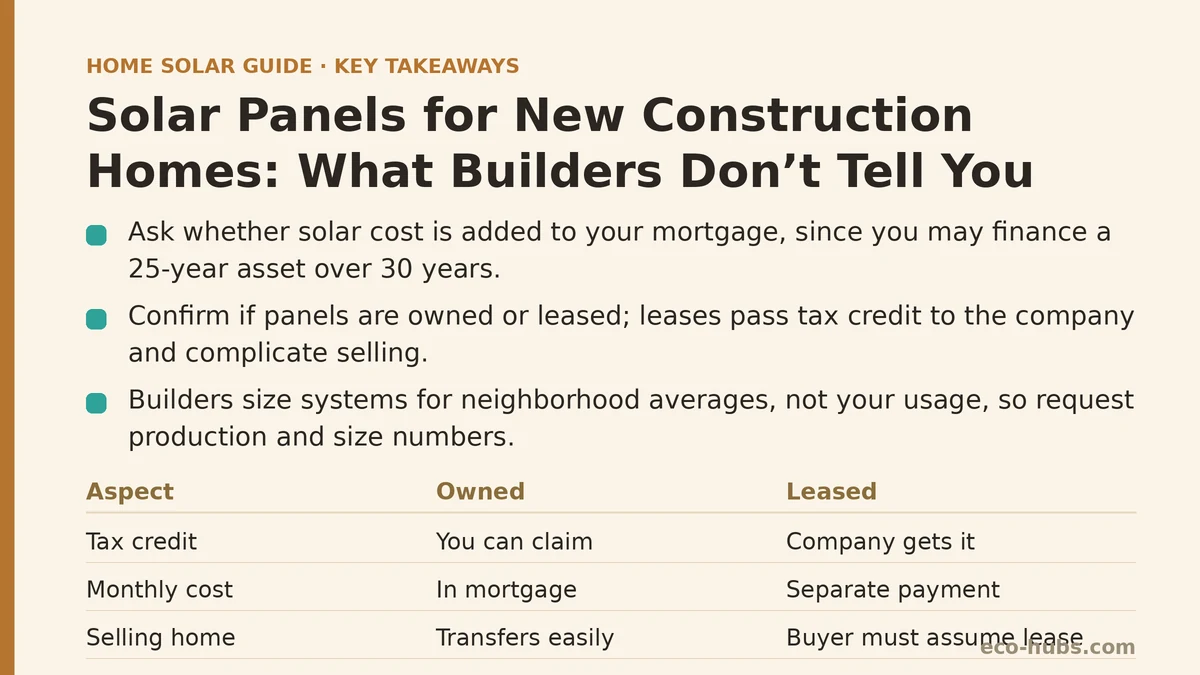
Q: Is the System Already Paid For, or Am I Paying for It Through the Mortgage?
This is the first question that separates a good deal from a bad one. Builders almost never install solar out of generosity. In most cases, the system cost is added to the home’s base price or listed as a line item on the purchase agreement. That means you are financing a 25-year asset over a 30-year mortgage, with interest. A system that costs the builder $18,000 to install might add $22,000 to your loan balance by the time interest accrues, and your monthly payment rises by roughly $110 to $130 per month on a 30-year fixed loan at 6.5 percent.
The math still works if the system offsets enough electricity. But you need to see the actual numbers, not a brochure estimate. Ask for the system’s annual production estimate in kilowatt-hours, the price per watt the builder paid, and the monthly mortgage increase attributable to solar. Compare that against your expected electricity bill. If the builder cannot or will not provide these figures, treat that as a red flag.
Q: Do I Own the Panels, or Is This a Lease or PPA?
Builders have increasingly partnered with solar leasing companies to offer “no money down” solar on new homes. This is not automatically bad, but it changes your situation in three ways. First, you do not own the system and cannot claim the federal solar tax credit—the leasing company gets that benefit. Second, the lease payments are a separate obligation from your mortgage, and they often escalate 2 to 3 percent annually. Third, selling the home becomes more complicated because the buyer must qualify for and assume the lease, or you must buy out the remaining term.
Owned systems, by contrast, transfer with the home as a real property improvement. The federal tax credit can be claimed—assuming the system is placed in service during the year you take possession—and there is no ongoing lease payment. If your builder offers both options, ask for the total cost of ownership over 10 years for each path. The lease will look cheaper monthly, but the owned system typically wins on total cost and resale flexibility.
Q: What Size System Is Installed, and How Was That Size Determined?
Builders do not size systems for yourspecific usage. They size them for the neighborhood’s average, or for the maximum roof area they can equip cost-effectively. A 4.0 kW system might be the standard package for a 2,200-square-foot floor plan, even if one household uses 8,000 kWh per year and another uses 14,000. Your actual usage will land somewhere different from the average.
You need three numbers to evaluate this. First, the system’s DC capacity in kilowatts. Second, the annual production estimate in kWh—ask for the specific software tool and shading assumptions used. Third, your own projected annual usage. For a new home, you can approximate by looking at your current home’s usage and adjusting for square footage, insulation, and appliance efficiency. If the system covers less than 80 percent of your projected usage, you will be paying the builder for a system that does not meet your needs, and you will still face substantial utility bills.
Q: Does the Builder’s Price Reflect Fair Market Value?
Builders often mark up solar systems substantially. A system that costs $2.80 per watt for a direct-to-consumer installer might be priced at $3.50 to $4.00 per watt in a new construction package because the builder is acting as a middleman and rolling in their own margin. On a 6 kW system, that difference is $4,200 to $7,200.
You can check this by getting an independent quote from a local installer for the same system size and equipment. If the builder’s price is more than 20 percent higher, you have leverage. Some builders will credit you the difference or allow you to exclude the system and have an installer add it after closing. Some will not negotiate at all. But you will not know unless you ask.
Q: What Equipment Is Installed, and Who Warrants It?
A typical new construction solar package uses budget-tier panels and a string inverter. There is nothing wrong with budget equipment if it performs to its spec, but you should know what you are getting. Ask for the exact panel model, inverter model, and racking system. Look up the manufacturer warranties. Panel product warranties typically run 25 years, but performance warranties vary—some guarantee 80 percent output at year 25, others only 75 percent. String inverters usually carry a 10- to 12-year warranty, and replacing one costs $1,500 to $3,000 including labor.
The bigger issue is who backs the installation. The builder’s electrical subcontractor did the wiring, not a solar-specific installer. That subcontractor may have no solar experience and no ongoing relationship with the equipment manufacturer. If a connector fails or a rapid shutdown device malfunctions, the manufacturer will point to improper installation, and the subcontractor may be long gone. Ask for the installation company’s name, verify they are licensed for solar work, and confirm they will honor a workmanship warranty for at least five years. If the builder cannot name the specific company, keep pushing.
Q: Is the House Solar-Ready If No Panels Are Installed?
If your builder offers solar as an optional upgrade, you might assume you can simply add panels later without issues. That assumption costs money. A solar-ready home has a few specific features: a 1-inch conduit from the attic to the main electrical panel, a dedicated breaker space, a roof area with unobstructed southern or southwestern exposure, and a main panel rated for the additional current. Many new homes lack at least one of these. Retrofitting conduit and upgrading a panel adds $2,000 to $4,000 to your installation cost.
Before closing, ask for documentation of these features in writing. Also ask whether the roof structure is rated for the additional load. A standard residential roof handles 20 pounds per square foot of live load, but solar racking adds roughly 3 to 5 pounds per square foot. Most roofs handle this, but some engineered trusses do not. If the builder cannot confirm, a structural engineer’s inspection costs a few hundred dollars and prevents a much larger problem later.
Q: What Happens If the System Fails After I Close?
This is where builders’ silence is most expensive. The builder’s warranty on the home often excludes solar equipment. The equipment warranty is separate, and the installation warranty belongs to the subcontractor, not the builder. If your inverter dies in year four, you will be contacting the inverter manufacturer directly, and their warranty covers the part—not necessarily the labor to replace it. Labor costs for a 30-minute swap on a ground-level inverter run $300 to $600. For a roof-mounted system where the wiring path is unclear, labor can exceed $1,000.
Before closing, ask the builder to put in writing who is responsible for warranty claims on the solar system: the builder, the installer, or the manufacturer. Ask for the installer’s warranty term specifically covering workmanship. And ask what happens if the installer goes out of business mid-warranty. If the builder deflects or equates “we stand behind our homes” to solar coverage, get a legal review of your purchase agreement before you sign.
Q: Can I Change the System Before Construction Is Complete?
During the pre-construction phase, you have more leverage than after closing. If the standard system is too small, ask for an upgrade and get the marginal price per kW. Sometimes builders can add one or two panels for as little as $800 to $1,200 per kW, which is cheaper than adding them later. If the standard system is too large or too expensive, ask to remove it entirely and receive a credit. Some builders will allow this, especially if it is framed as a request to keep working with an installer you already use.” Others will not, because the solar package is part of their standard offering and removing it changes their cost structure.
You can also ask for a specific equipment change mid-build. Swapping a string inverter for microinverters costs $500 to $1,000 extra but improves per-panel performance and simplifies future repairs. Most builders will accommodate if you pay the difference, provided the change is made before installation begins.
Q: How Does This Affect My Home’s Resale Value?
Solar on new construction is marketed as an asset, but the data is mixed. Studies show homes with owned solar sell for a premium of roughly 3 to 4 percent, but leased solar often sells at par or slightly below. The premium also depends on how common solar is in your market. In areas where 30 percent of homes have solar, the premium shrinks. In areas where less than 5 percent have it, a solar home stands out and sells faster.
The more relevant metric is your timeline. If you plan to stay 10 years or more, an owned system that covers 80 percent of your usage pays for itself through avoided utility bills. If you plan to move in 3 to 5 years, the system may not have delivered enough savings to offset the price you paid, and you will be relying on the resale premium to break even. That is a bet against certain market conditions.
A Quick Checklist to Take to the Builder’s Office
| Item | What to Ask | What a Straight Answer Looks Like |
|---|---|---|
| Ownership | Do I own the system or is it leased? | Owned, title transfers at closing |
| Price breakdown | What is the cost per watt and monthly mortgage impact? | Printed line item with both numbers |
| Production estimate | What annual kWh does the software model project? | A number, plus the tool and shading assumptions used |
| Equipment list | Exact panel and inverter models | Specific model numbers, not “high efficiency” |
| Warranty chain | Who warranties the equipment vs. the installation? | Named companies and specific term lengths |
| Solar-ready features | Conduit, panel capacity, roof load | Written confirmation with details |
| Resale impact | How does this system transfer on resale? | Documented policy from the builder |
What to Do Next
Before you sign the purchase agreement, ask the builder for a written solar disclosure covering each item in the checklist above. If they provide it, review it against your own usage history and an independent quote from a local installer. If they will not provide it, decide whether the risk is acceptable given the price you are paying.
If the system is already installed and you are past closing, your options are narrower. The first move is to document every component model number, warranty term, and installer name. The second is to get an inspection from a local solar professional—costing $300 to $500—who can identify installation defects and warrantable issues before the equipment warranty clock runs out. The third is to contact the manufacturer directly for any component that fails, rather than relying on the builder to mediate.
Are you in the middle of a new construction purchase right now? Take the checklist above to your builder this week and fill it out in writing before you commit. If you are unsure which numbers matter most—or how to push back on the price per watt—leave your situation in the comments and we will help you compare it against fair market range.
Related guides: Solar Panel Monitoring Systems: What the Apps Actually Tell You, Solar Panels and Homeowners Insurance: What You Need to Know, and What Happens to Solar Panels at the End of Their Life: A Recycling Guide.
🔗 Recommended Reading
- Solar Panel Monitoring Apps: A Setup Guide for Beginners
- How to Read Your Electricity Bill After Solar: A Line-by-Line Walkthrough
- Solar Incentive Paperwork: Common Filing Mistakes That Delay Your Rebate
- Home Battery Sizing Mistakes That Lead to Blackout Regret
- Common Solar Installer Mistakes Homeowners Should Catch Before Signing