A solar panel warranty is a contractual promise, usually from the manufacturer, that a panel will perform at a specified level and remain free of defects for a set period, typically 25 years for output performance and 10 to 25 years for the physical product itself. That single sentence hides a lot of nuance, because “warranty” on a solar quote can refer to at least three separate agreements with different issuers, different durations, and different remedies. Understanding which one covers which problem is the difference between a smooth claims process and a frustrating dispute over who is responsible for a failing system.
What Types of Warranties Actually Exist on a Solar System?
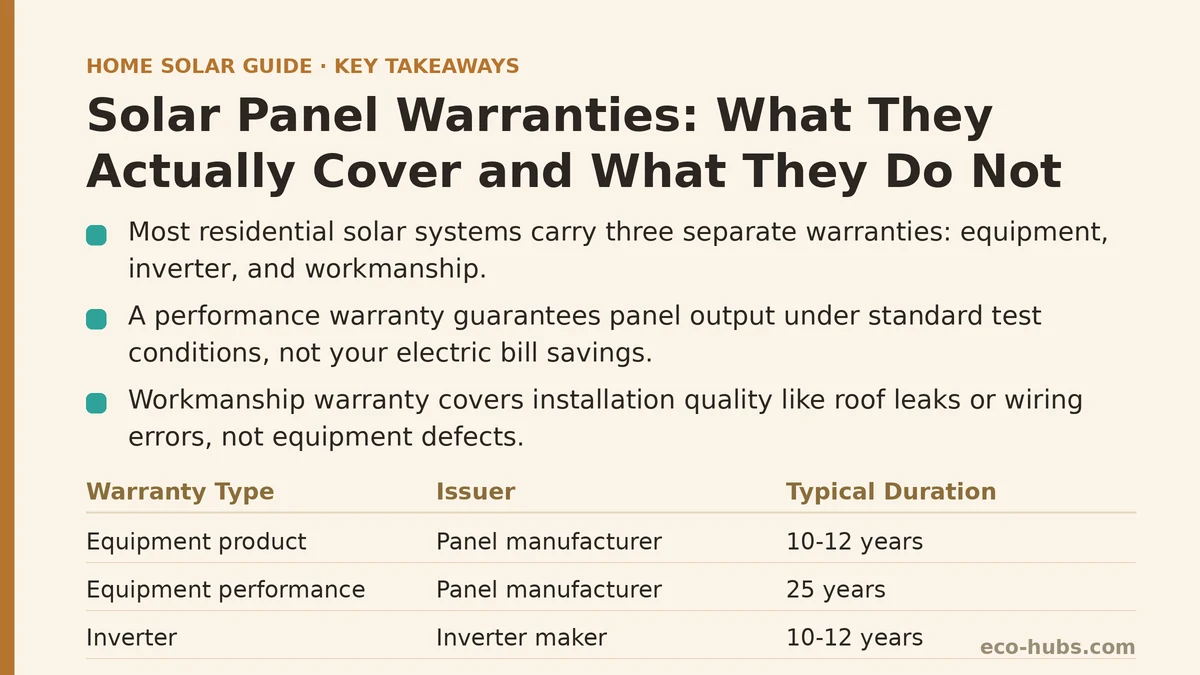
Most residential systems carry three distinct warranties, and homeowners often assume they’re one combined package. They are not.
The equipment warranty comes from the panel manufacturer and typically splits into two parts: a product warranty covering manufacturing defects (usually 10 to 12 years, sometimes extending to 25 on premium panels) and a performance warranty guaranteeing the panel won’t degrade below a certain output threshold, commonly 80–92% of original capacity by year 25. The inverter warranty is separate and issued by whichever company made the inverter, not the panel manufacturer, and it is frequently shorter — often 10 to 12 years for string inverters, though some microinverter brands offer 25-year terms. The workmanship warranty comes from the installer, not the manufacturer, and covers labor and installation quality: roof penetrations, wiring, mounting hardware, and whether the system was put together correctly in the first place.
These three warranties can expire at different times and be backed by entirely different companies, which matters more than most homeowners expect until something goes wrong.
Does the Performance Warranty Guarantee My Electric Bill Savings?
No, and this is one of the more common misunderstandings. A performance warranty guarantees that the panel itself will produce electricity at a certain percentage of its rated capacity under standard test conditions — it says nothing about your actual electric bill, your household’s usage patterns, or your local weather. Shading from a tree that grew in over eight years, a utility rate change, or simply using more electricity than before can all reduce your savings without the panel warranty being violated in any way.
If your production estimate was based on assumptions discussed in a proposal, and that estimate turns out to be inflated, the performance warranty won’t help you, since the panels can still meet their guaranteed degradation curve while producing less than you expected for entirely separate reasons.
What Does the Workmanship Warranty Cover That the Manufacturer’s Warranty Does Not?
The workmanship warranty is specifically about how the system was installed, not how the equipment itself was built. A roof leak from a poorly sealed mounting bracket, a wiring error causing an inverter fault, or a rack installed at the wrong angle all fall under workmanship, not equipment defects. If a panel underperforms because of a manufacturing flaw, that’s the manufacturer’s problem. If it underperforms because it was wired incorrectly, that’s the installer’s problem, and only the workmanship warranty applies.
This distinction matters because workmanship warranties are usually shorter — often 5 to 10 years, sometimes up to 25 on paper from larger installers — and they are only as reliable as the installer’s continued existence. A manufacturer with decades of history is a fundamentally different backstop than a regional installer that could close within a few years of your installation.
What Happens If My Installer Goes Out of Business?
This is the scenario that catches homeowners off guard most often. If the installer that provided your workmanship warranty closes or stops operating, that specific warranty typically becomes unenforceable, regardless of how many years were originally promised on paper. There is generally no automatic transfer to another company and no fallback fund that pays out in their place.
The equipment warranties are usually more resilient in this situation, since they’re backed by the manufacturer directly rather than the installer, though even manufacturers can go out of business, which is why panel brands with a long operating history and financial stability are worth weighing alongside efficiency specs when comparing quotes. Asking directly whether any manufacturer-backed coverage persists independent of the installer’s continued operation is a reasonable question to raise before signing anything.
Are There Situations Where None of the Warranties Apply?
Yes, and this is worth knowing before an issue arises rather than after. Common exclusions across most manufacturer and installer warranties include:
- Damage from severe weather events like hail, hurricanes, or falling debris (often covered by homeowner’s insurance instead, not the solar warranty)
- Damage caused by unauthorized modifications or repairs performed by someone other than a certified technician
- Normal wear that falls within the guaranteed degradation curve, even if it feels like a meaningful drop in output
- Issues traced to improper maintenance, such as debris buildup left unaddressed for years
- Pre-existing roof problems unrelated to the solar installation itself
A degrading panel that’s still within its guaranteed performance curve is a frustrating outcome for a homeowner, but it isn’t a warranty violation, and pursuing a claim in that situation usually goes nowhere.
How Do I Actually File a Warranty Claim?
The process differs depending on which warranty applies. For an equipment issue, you typically contact the installer first, since they usually handle the paperwork and communication with the manufacturer on your behalf, though you can often contact the manufacturer directly if the installer is unresponsive or no longer operating. For a workmanship issue, the installer is the sole point of contact, since no other party is responsible for their labor.
Documentation matters considerably here. Keeping your original contract, warranty certificates, installation date, and any production monitoring data from your system’s app makes a claim faster to process and harder to dispute, since you can show exactly when performance dropped and compare it against the guaranteed curve.
Warranty Comparison at a Glance
| Warranty Type | Who Backs It | Typical Length | Covers |
|---|---|---|---|
| Product (equipment) | Panel manufacturer | 10–25 years | Manufacturing defects |
| Performance | Panel manufacturer | 25 years | Output degradation below guaranteed threshold |
| Inverter | Inverter manufacturer | 10–25 years | Inverter defects and failure |
| Workmanship | Installer | 5–25 years (installer-dependent) | Installation errors, roof penetrations, wiring |
What Questions Should I Ask Before Signing, Specifically About Warranties?
Before committing to an installer, it’s worth asking directly: what exactly does the workmanship warranty cover, and for how long? If a problem could plausibly be either a manufacturing defect or an installation error, who determines which warranty applies, and how is that decision made? Is there any coverage that persists independently of the installer staying in business? These aren’t hostile questions — a reputable installer should be able to answer all three without hesitation, and hesitation on any of them is itself useful information.
Do you already have a solar quote in hand with warranty terms listed, or are you still comparing installers? Share what you’re seeing in writing, and it’s often possible to spot gaps between the manufacturer and installer coverage before you sign rather than after. Related guides: Solar Panel Efficiency Degradation Over Time: What Actually Slows Down, Solar Panel Financing Options: What Actually Differs Between Loan Types, and Solar Panel Installation Process Step by Step: What Actually Happens.
🔗 Recommended Reading
- Solar Panel Monitoring Apps: A Setup Guide for Beginners
- How to Read Your Electricity Bill After Solar: A Line-by-Line Walkthrough
- Solar Incentive Paperwork: Common Filing Mistakes That Delay Your Rebate
- Home Battery Sizing Mistakes That Lead to Blackout Regret
- Common Solar Installer Mistakes Homeowners Should Catch Before Signing