By the end of this post, you’ll be able to look at a manufacturer’s degradation rate on a spec sheet, know roughly what your system’s output should look like in year 10 and year 25, and understand which five factors are doing most of the work behind that number. That’s a useful skill, since degradation rate gets buried in fine print far more often than it gets explained clearly.
Every solar panel produces slightly less electricity each year than it did the year before. This is normal, expected, and already priced into the production estimates a reputable installer gives you. The question worth understanding isn’t whether degradation happens — it’s which factors influence how fast it happens, and how much that should matter to your specific purchase decision.
Below are the five factors that most affect long-term panel efficiency, ranked from the one you have the least control over to the one you have the most.
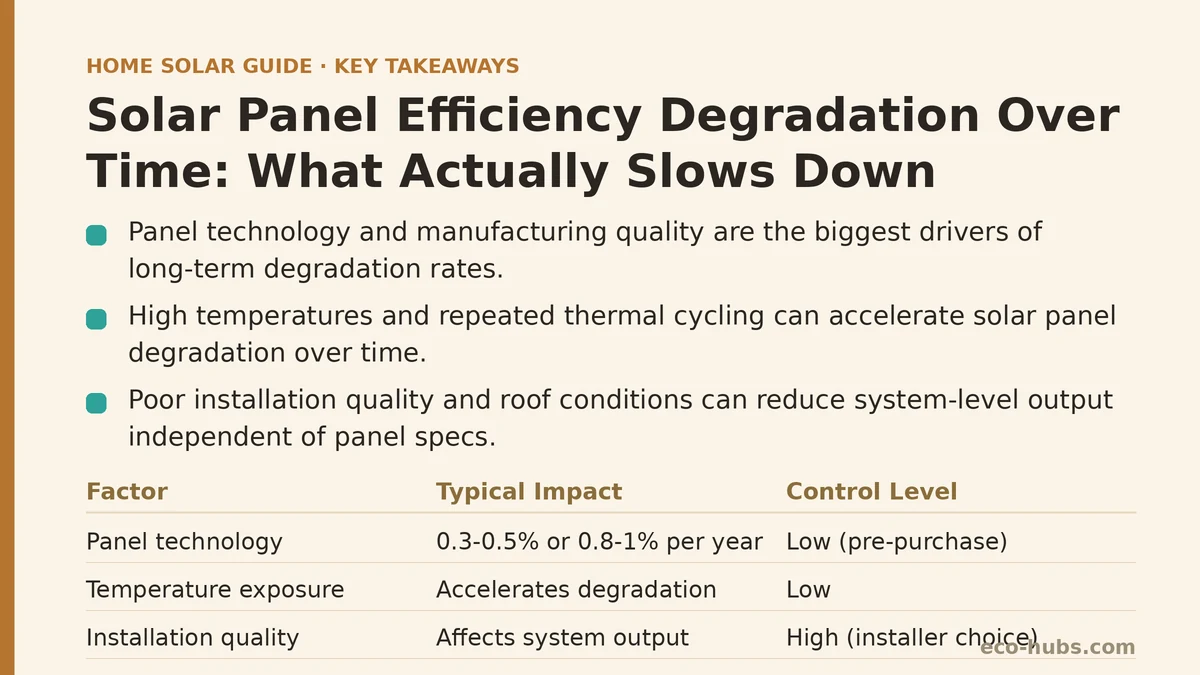
1. Panel Technology and Manufacturing Quality
This is the single biggest driver of long-term output, and it’s set the moment you choose which panels to buy. Monocrystalline panels from established manufacturers with strong quality control typically degrade around 0.3% to 0.5% per year. Cheaper or less rigorously tested panels can degrade at closer to 0.8% to 1% annually — a difference that compounds meaningfully over a 25-year system life.
Do the math on that gap: a panel starting at 400 watts and degrading at 0.5% annually is still producing roughly 351 watts after 25 years. The same panel degrading at 1% annually drops to around 311 watts over the same period. That’s a real difference in cumulative electricity generated, and it traces directly back to a manufacturing and materials decision made before the panel ever reached your roof.
Worth checking directly: the manufacturer’s published degradation curve, not just their headline efficiency percentage. A slightly lower starting efficiency paired with a slower degradation rate can outperform a higher starting efficiency paired with faster degradation, once you look at year 15 or year 20 rather than year one.
2. Temperature Exposure and Climate
Heat is harder on solar panels than most homeowners expect. Panels are rated under standard test conditions at 77°F, but real rooftop temperatures regularly climb well above that, especially in southern and desert climates. Higher operating temperatures reduce a panel’s instantaneous output and, over years of repeated thermal cycling, can contribute to faster long-term degradation than the same panel would show in a milder climate.
This isn’t a reason to avoid solar in hot regions — production estimates for those regions already factor in local temperature effects. It’s simply a reason to pay attention to a panel’s temperature coefficient, which describes how much output drops per degree above the standard testing temperature. A lower (less negative) temperature coefficient generally holds up better in consistently hot conditions.
3. Installation Quality and Roof Conditions
How well a system is mounted affects more than day-one performance. Poor ventilation behind panels traps heat, which circles back to the temperature effect above. Improper racking can introduce mechanical stress on panels over time, and sloppy wiring connections can degrade faster than the panels themselves, dragging down system-level output even if individual panels are performing to spec.
This is one reason the installer selection questions we cover in our dedicated guide matter beyond the initial installation price. A rushed or inexperienced install can quietly shave years off a system’s effective performance life, even when every individual component carries a strong warranty.
4. Maintenance and Cleaning Habits
Dust, pollen, bird droppings, and general grime reduce output in the short term, and in dry, low-rainfall regions this buildup can accumulate meaningfully over months rather than washing away naturally. This factor doesn’t affect the panel’s underlying degradation curve — a dirty panel isn’t degrading faster, it’s just producing less right now — but the practical difference to your electricity bill can look similar if cleaning is neglected for long stretches.
Worth doing periodically: a visual check after pollen season or extended dry spells, and a professional cleaning if your region doesn’t get regular rain to do the job naturally. This is a low-cost way to make sure your system’s actual output stays close to its true degradation-adjusted potential rather than falling short of it for avoidable reasons.
5. Monitoring and Early Problem Detection
The factor you have the most ongoing control over is simply whether you’re watching your system’s performance closely enough to catch a problem early. A single failing panel, a loose connection, or a malfunctioning inverter can drag down an entire string’s output well beyond what normal degradation would explain — and without monitoring, that loss can go unnoticed for months or longer.
Most modern systems include panel-level or string-level monitoring through an app or web portal. Worth doing regularly: comparing your actual monthly production against your original estimate, adjusted for season and normal degradation. A gap that’s larger than expected, especially one that shows up suddenly rather than gradually, is worth investigating rather than assuming it’s just the panels aging on schedule.
How These Five Factors Compare
| Rank | Factor | Your Level of Control | Typical Impact |
|---|---|---|---|
| 1 | Panel technology/manufacturing | Low (set at purchase) | 0.3%–1%+ annual degradation, compounding over 25 years |
| 2 | Temperature and climate | Low (location-dependent) | Faster degradation in consistently hot conditions |
| 3 | Installation quality | Medium (installer-dependent) | Can shorten effective performance life |
| 4 | Maintenance and cleaning | High | Short-term output loss, not true degradation |
| 5 | Monitoring and early detection | High | Determines how quickly other losses get caught |
What This Means for Your Own System
The first two factors on this list are largely locked in before your panels are ever mounted, which is exactly why comparing degradation curves and temperature coefficients across manufacturers matters more than comparing headline efficiency numbers alone. The last three factors, by contrast, stay within your influence for the entire life of the system — a well-installed system that’s monitored and occasionally cleaned will consistently outperform an identical system that’s neglected on all three fronts.
Considering panels for a new installation, or trying to make sense of an existing system’s output compared to its original estimate? Share where you’re starting from, and we can help you work out whether the numbers you’re seeing line up with a normal degradation curve or point to something worth a closer look.
Related guides: Solar Panel Maintenance: What to Actually Expect Over Time, Solar Panel Degradation: What to Expect Over 25 Years, and Solar Panel Financing Options: What Actually Differs Between Loan Types.
🔗 Recommended Reading
- Solar Incentive Paperwork: Common Filing Mistakes That Delay Your Rebate
- Home Battery Sizing Mistakes That Lead to Blackout Regret
- Common Solar Installer Mistakes Homeowners Should Catch Before Signing
- Common Home Battery Storage Wiring and Placement Mistakes to Avoid
- Solar Payback Period vs Cash-on-Cash Return: Which Metric Should Homeowners Use