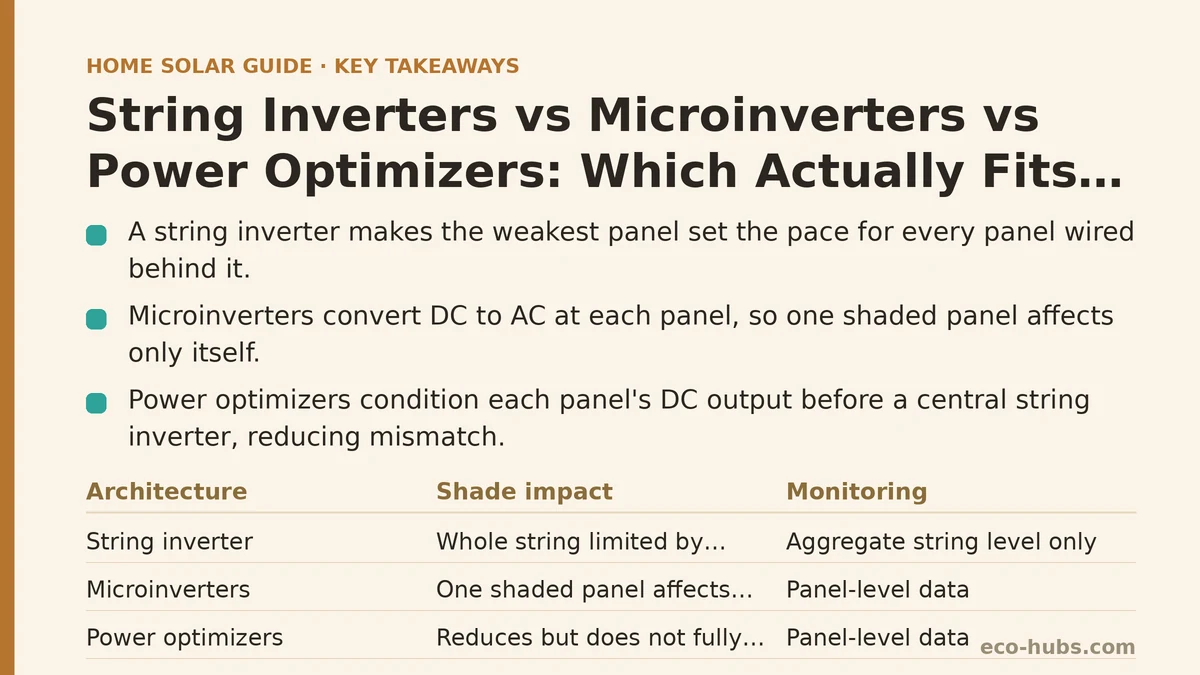
One shaded panel, on a roof of twelve, can drag down the output of the entire array — not just its own share. That’s how a traditional string inverter behaves: the weakest panel in the chain sets the pace for every panel wired behind it. Microinverters and power optimizers exist specifically to break that dependency, but neither is a universal upgrade, and each comes with its own cost, complexity, and failure profile. The right choice depends less on which technology sounds most advanced and more on what your specific roof, budget, and monitoring needs actually require.
Symptom: Production Drops Sharply Whenever One Area of the Roof Is Shaded
If your system’s output falls by far more than the shaded area’s proportional share — say, a 15% shade on one section causing a 40% production drop — the cause is almost always a string inverter architecture paired with panels wired in series. In that setup, current flows through every panel sequentially, so the lowest-producing panel in the string limits what every other panel in that same string can contribute, regardless of how much sun the rest of the array is receiving.
Fix: Microinverters, which convert DC to AC at each individual panel, eliminate this dependency entirely — one shaded panel affects only itself. Power optimizers offer a middle path: they don’t convert power at the panel, but they do condition the DC output of each panel independently before sending it to a central string inverter, which substantially reduces (though doesn’t fully eliminate) the mismatch penalty. For roofs with multiple orientations, dormers, chimneys, or tree lines that shade only part of the array during the day, either option typically outperforms a straight string inverter setup by a meaningful margin.
Symptom: You Can’t Tell Which Specific Panel Is Underperforming
A homeowner monitoring a string-inverter system typically sees one combined production number for the whole string, sometimes broken out by inverter if there are multiple strings — but not by individual panel. If a single panel develops a fault, degrades unevenly, or gets covered in debris, that problem is invisible until the aggregate number looks low enough to investigate.
Fix: Microinverters and power optimizers both report panel-level data through their monitoring platforms, letting you (or your installer) pinpoint a specific underperforming panel rather than troubleshooting an entire string. This diagnostic clarity is one of the most underrated advantages of panel-level electronics, and it matters most on larger systems where isolating a single faulty panel among twenty or more would otherwise require a technician visit with test equipment.
Symptom: Your Installer Quoted a Noticeably Higher Price Than Expected
If a quote for panel-level electronics — microinverters especially — comes in visibly higher than a comparable string inverter quote, that’s not necessarily a sign of being overcharged. Microinverters generally carry a higher per-watt equipment cost, since you’re purchasing one inverter unit per panel rather than a single central unit for the whole array. Power optimizers sit in between, since the central string inverter is still required alongside the optimizer for each panel.
Fix: Compare quotes on a like-for-like basis: same panel count, same wattage, and — ideally — the same brand tier of equipment. A meaningful price gap is expected between architectures; a price gap between two quotes for the same architecture deserves closer scrutiny of what else might differ, such as labor, racking, or monitoring hardware included in one bid but not the other.
Symptom: Your Roof Has No Shading Issues but You’re Still Being Pushed Toward Microinverters
Some installers default to recommending microinverters regardless of roof conditions, partly because they’re simpler to design around (no string-length calculations) and partly because the margin can be higher. If your roof is a single, unobstructed, south-facing plane with no shading concerns, the shade-mitigation argument for microinverters largely disappears.
Fix: Ask directly whether a string inverter would perform comparably on your specific roof, and request the reasoning if the installer still recommends otherwise. On an unshaded, single-orientation roof, a well-sized string inverter can perform within a small percentage of a microinverter system’s output, often at a noticeably lower equipment cost. Panel-level monitoring is still a nice-to-have in this scenario, but it’s a smaller factor when there’s little mismatch risk to catch.
Symptom: One Inverter Failure Took Down Your Entire System
With a string inverter, a single point of failure — the inverter itself — can knock out production from the whole array until it’s repaired or replaced. This is a structural tradeoff of centralizing conversion in one device, and it’s worth weighing against the higher combined cost of many smaller inverters, since more units also means more individual components that could eventually need service.
Fix: With microinverters, a single unit failing affects only its own panel, and the rest of the array keeps producing normally. Power optimizers fall in between again: an optimizer failure typically affects only its panel, but a failure in the central string inverter still affects the whole string, since the inverter itself is a single shared component. If minimizing single-point-of-failure risk is a priority — for instance, if a roof is hard to access and repair visits are costly — that consideration alone can tip the decision toward microinverters even on an otherwise unshaded roof.
Symptom: You’re Planning to Add Panels or a Battery Later and Want to Avoid Redesigning the Whole System
Expanding a string inverter system later can be constrained by the inverter’s maximum input capacity and the electrical characteristics required for balanced strings, sometimes requiring a second inverter or a full re-string of the array to add capacity cleanly.
Fix: Microinverter and power-optimizer systems tend to scale more incrementally, since each new panel typically comes with its own inverter or optimizer rather than needing to fit into an existing string’s electrical profile. If future expansion is a real possibility rather than a hypothetical, mention this directly to your installer during design — it can change which architecture makes more sense even if your current shading and roof conditions would otherwise favor a string inverter.
Quick Diagnostic Reference
| Symptom | Likely Cause | Better-Fit Architecture |
|---|---|---|
| Disproportionate production loss from partial shading | Series-wired string, mismatch penalty | Microinverters or power optimizers |
| No panel-level visibility into production | String-level monitoring only | Microinverters or power optimizers |
| Higher-than-expected quote for panel electronics | Per-panel equipment cost | Compare like-for-like before assuming overcharge |
| Microinverters recommended despite unshaded roof | Default installer preference, not necessity | String inverter may perform comparably |
| Full system outage from one component failure | Centralized conversion, single point of failure | Microinverters reduce this risk |
| Planned future expansion | String capacity limits on re-design | Microinverters or power optimizers scale more easily |
Matching the Fix to Your Actual Roof
None of these three architectures is universally “better” — each solves a specific set of problems at a specific cost. A simple, unshaded roof with no expansion plans rarely needs the added cost of panel-level electronics. A complex roof with multiple orientations, partial shading, or a strong interest in panel-level diagnostics is where microinverters and power optimizers earn their higher price tag. Walk through the symptoms above against your own roof’s actual conditions, rather than the general reputation either technology carries, and the right fit tends to become clear fairly quickly.
Which of these symptoms sounds closest to your situation — shading concerns, monitoring visibility, cost comparison, or future expansion plans? Share your roof layout and current quote details, and we can help narrow down which architecture actually fits your specific system. Related guides: Monocrystalline vs Polycrystalline vs Thin-Film: Which Panel Type Actually Fits Your Roof, Do Solar Panels Work During a Power Outage? It Depends on Your System Type, and Does Solar Actually Increase Your Home’s Value? What the Evidence Shows.
🔗 Recommended Reading
- Solar Panel Monitoring Apps: A Setup Guide for Beginners
- How to Read Your Electricity Bill After Solar: A Line-by-Line Walkthrough
- Solar Incentive Paperwork: Common Filing Mistakes That Delay Your Rebate
- Home Battery Sizing Mistakes That Lead to Blackout Regret
- Common Solar Installer Mistakes Homeowners Should Catch Before Signing