Say you are trying to sell a house that has had solar panels on the roof for the past six years, and your real estate agent asks a simple question you cannot immediately answer: do you own the system outright, or are you still making monthly payments on a lease? That one detail determines whether the panels are a straightforward selling point or a source of paperwork that can stall a closing for weeks. The distinction matters more than most sellers expect, and it is worth sorting out long before a buyer ever walks through the door.
Step 1: Figure Out Exactly What You Have
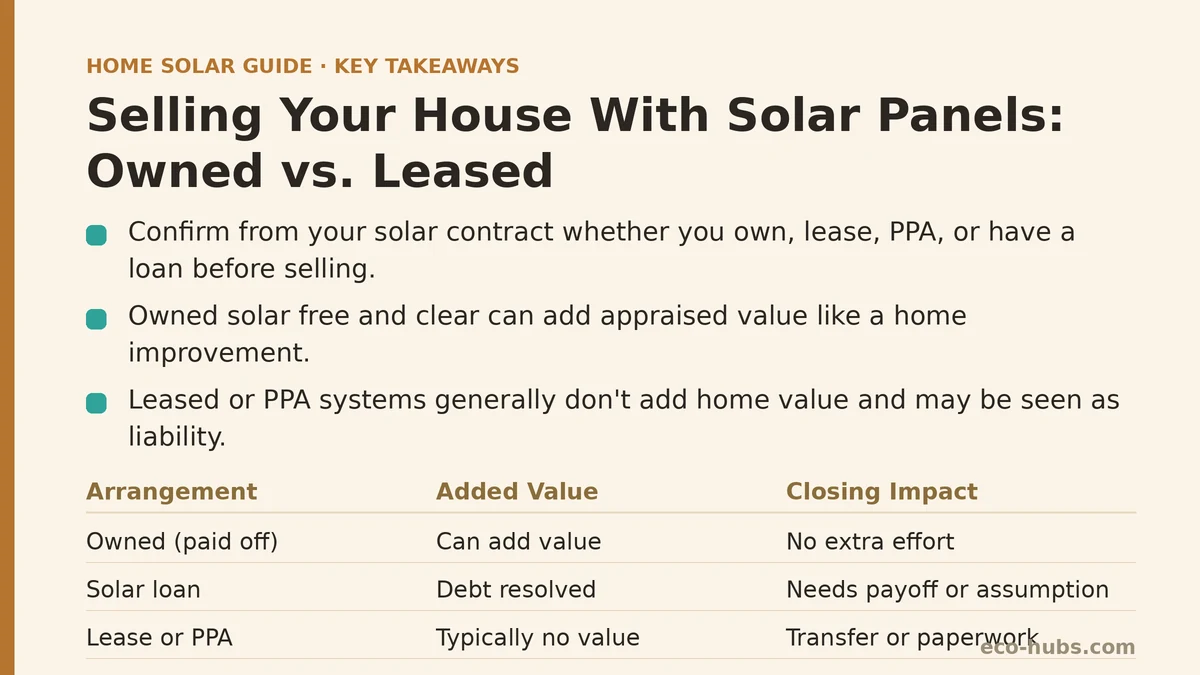
Before anything else, pull out your original solar contract and identify which of four arrangements you’re dealing with: a cash purchase, a solar loan with the panels serving as collateral or tied to a home equity product, a lease, or a power purchase agreement (PPA) where you pay for the electricity the system generates rather than the equipment itself. Homeowners sometimes misremember which category they fall into, especially years after signing, so confirm this from the paperwork rather than memory. The contract type will dictate nearly every step that follows.
If you’re unsure, your monthly solar bill (or the absence of one) is a decent clue. A flat lease payment or a per-kilowatt-hour charge on a separate statement usually points to a lease or PPA. No ongoing solar-specific bill at all typically means the system is either paid off or was financed through a loan that’s since been settled.
Step 2: Understand How Ownership Changes the Appraisal Conversation
An owned solar system, free and clear of any loan, is generally treated as a home improvement that can add to appraised value, similar to a renovated kitchen or a new roof. Appraisers don’t always have a standardized method for valuing solar specifically, but many will factor in energy savings and system age when comparable sales data supports it. This is one of the few scenarios where solar panels work in your favor during a sale with essentially no extra effort on your part.
A leased system or one under a PPA is a different story. Because you don’t own the equipment, appraisers typically don’t count it toward the home’s value at all. Some buyers even view a lease as a liability rather than a feature, since they’d be inheriting monthly payments for equipment they don’t own. This doesn’t mean leased solar makes a house unsellable, but it does mean you shouldn’t expect the panels to boost your asking price the way an owned system might.
Step 3: Address an Outstanding Solar Loan
If you financed the system and still owe money on it, that debt needs to be resolved before or at closing, similar to how a second mortgage would be handled. Some solar loans are secured against the home itself, which means a lien search during the sale process will surface the balance regardless of whether you mention it upfront. Paying off the loan from sale proceeds is common and usually the cleanest path, since it clears the lien and lets the buyer take the home without any solar-related debt attached.
Occasionally a buyer will agree to assume the remaining loan balance, particularly if the interest rate is favorable, but this requires the lender’s approval and isn’t guaranteed to go smoothly. Confirm with your loan servicer early whether assumption is even an option for your specific loan, since not all solar financing products allow it.
Step 4: Start the Lease or PPA Transfer Process Early
If your system is leased or under a PPA, the sale hinges on transferring that agreement to the new homeowner, and this is where timelines can slip. Most solar leasing companies require the buyer to apply for transfer approval, which typically includes a credit check similar to what’s required for a mortgage. This process can take several weeks, so starting it the moment you accept an offer — rather than waiting until closer to closing — gives you a much better chance of staying on schedule.
Some leasing companies also charge a transfer fee, and terms vary by provider, so contact yours directly to get exact figures rather than relying on general assumptions. It’s worth having this information ready to share with potential buyers before they even make an offer, since surprise fees discovered mid-transaction tend to create friction that a little upfront transparency avoids.
Step 5: Prepare for Buyer Hesitation and Have Answers Ready
Buyers who haven’t dealt with solar before often have questions that go beyond what a typical listing sheet covers, and a leased system tends to generate more of these than an owned one. Be ready to explain the remaining lease term, the monthly payment amount, any annual price escalator built into the contract, and what happens if the buyer’s credit doesn’t qualify for transfer approval. Buyers who understand the terms upfront are far less likely to walk away mid-process than those who discover a monthly obligation they weren’t expecting during underwriting.
For owned systems, the questions tend to be more practical: system age, any transferable manufacturer or workmanship warranty (details on which are covered in our warranty guide), and average production over the past year or two. Having utility bills or a monitoring app history on hand to show real production numbers tends to reassure buyers more effectively than an estimate alone.
Step 6: Watch for Buyer Financing Complications
A house with an unpaid solar loan or an active lease can occasionally complicate the buyer’s own mortgage approval, since some lenders factor the lease payment into the buyer’s debt-to-income ratio the same way they would a car payment. This is worth flagging to your agent early, since it can narrow the pool of qualified buyers or require additional documentation during underwriting. It’s a manageable issue in most cases, but one that’s easier to plan around than to react to mid-transaction.
Step 7: Price and Market the Home With the Right Framing
For owned systems, it’s reasonable to highlight the panels as a value-adding feature in your listing, backed by real production data and remaining warranty coverage where applicable. For leased systems, the more effective approach is usually transparency rather than promotion — presenting the lease as a manageable, transferable arrangement rather than trying to frame it as a premium upgrade the buyer should pay extra for. Overselling a leased system tends to backfire once a buyer digs into the actual terms.
Quick Reference: Owned vs. Leased at a Glance
| Factor | Owned System | Leased or PPA System |
|---|---|---|
| Appraisal impact | Can add measurable value | Typically adds none |
| Closing complexity | Low, unless a loan lien exists | Higher, requires lease transfer approval |
| Buyer credit check | Not required for the solar system itself | Often required by the leasing company |
| Marketing angle | Feature worth highlighting | Best framed transparently, not as a selling point |
| Timeline risk | Minimal | Moderate to significant if transfer starts late |
Step 8: Loop In Your Agent and the Solar Provider Together
The smoothest sales tend to involve early coordination between your real estate agent, your solar provider or lender, and eventually the buyer’s agent, rather than each party discovering details separately as the transaction moves along. If you’re a few months from listing, it costs nothing to call your solar company now and ask what documentation they’ll need for a future transfer or payoff. Having that information ready before a buyer is even in the picture tends to shave real time off the eventual closing.
Which category does your system fall into, and have you already contacted your solar provider about what a transfer or payoff would involve? If not, that’s a reasonable next call to make before your house even hits the market. Related guides: Do Solar Panels Work During a Power Outage? It Depends on Your System Type, How Solar Panels Affect Your Property Taxes, and How to Calculate How Many Solar Panels You Need for Your Home.
🔗 Recommended Reading
- How to Size a Solar System for Your Home: A Beginner's Step-by-Step Walkthrough
- Solar Panel Monitoring Apps: A Setup Guide for Beginners
- How to Read Your Electricity Bill After Solar: A Line-by-Line Walkthrough
- Solar Incentive Paperwork: Common Filing Mistakes That Delay Your Rebate
- Home Battery Sizing Mistakes That Lead to Blackout Regret