Say you are trying to decide whether to install solar before selling in two years, or whether the panels you already have will actually help when you eventually list the house. A real estate agent tells you solar “adds value.” A solar sales rep tells you the same thing, with a specific dollar figure attached. Neither claim is necessarily wrong, but neither one tells you what you need to know: value added under which conditions, in which market, and compared to what baseline.
The honest answer is that solar’s effect on resale price is real in aggregate but highly uneven in individual cases. Some of the factors that drive that unevenness are backed by solid research; others are more anecdotal than agents like to admit. Ranking them by strength of evidence, rather than treating “solar adds value” as one uniform fact, gives a much clearer picture of what to expect from your own house.
The Short Answer Before the Ranking
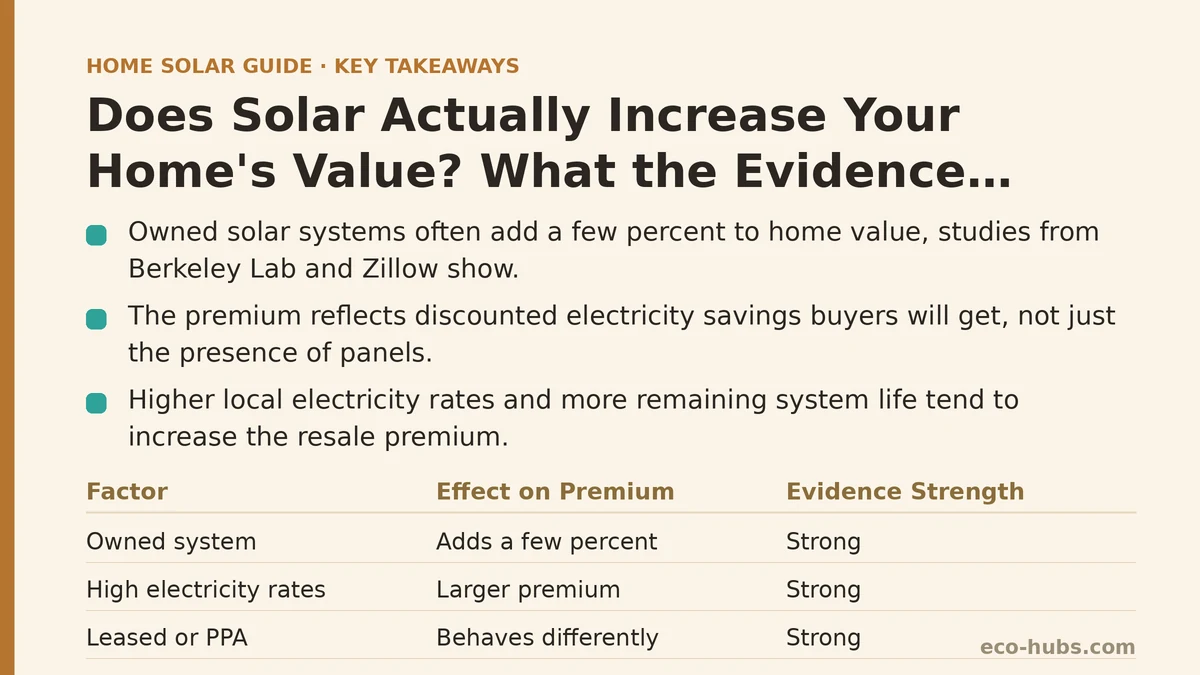
Owned solar systems, in most U.S. markets, do correlate with a resale premium — studies from Lawrence Berkeley National Laboratory and Zillow have both found measurable bumps, generally in the range of a few percent of home value depending on system size and region. That premium is not guaranteed, though, and it shrinks or disappears entirely under specific conditions covered below. Leased systems and power purchase agreements behave very differently from owned systems in this analysis, which is a distinction many homeowners don’t learn about until they’re already trying to sell.
Ranking the Evidence, From Strongest to Weakest
1. Appraisal and Sales-Data Studies (Strongest Evidence)
The most credible support for a solar value premium comes from studies that compare actual sale prices of solar and non-solar homes with similar characteristics — same neighborhood, similar square footage, comparable age. Berkeley Lab’s research across several states found premiums roughly in line with the value of the energy the system produces over its remaining life, discounted to present terms. That’s a meaningful distinction: the studies aren’t finding that buyers pay for “having solar” as a feature the way they’d pay for a renovated kitchen. They’re finding that buyers pay something close to the discounted value of the electricity savings the system will generate going forward.
This matters because it means the premium is not fixed. A newer, larger system with more years of production left will support a larger premium than an aging system nearing the end of its useful life, even in the same neighborhood.
2. Regional Electricity Prices
The size of any solar premium tracks closely with what electricity costs in your area. In states with high retail electricity rates — California, Massachusetts, and similar markets — a solar system saves a buyer more money every month, and appraisers and buyers alike tend to reflect that in what they’re willing to pay. In regions with cheap grid electricity, the same system produces the same electricity but saves the future owner far less money, and the resale premium tends to be correspondingly smaller or negligible.
This is one of the more consistent patterns across the research, and it’s also one of the more overlooked ones. A system’s local financial logic depends heavily on the rate structure it’s offsetting, both when you install it and when you eventually sell.
3. Ownership Status: Owned vs. Leased vs. PPA
This factor doesn’t get nearly enough attention in casual conversations about solar and home value, and it should probably rank higher on most homeowners’ concern list than it currently does. An owned system — paid for outright or through a loan that’s been paid off — transfers cleanly to the new owner and can support the appraisal premiums described above. A leased system or one under a power purchase agreement is a different animal entirely: the new buyer typically has to qualify for and assume the lease or PPA contract, which some buyers are reluctant to do and some mortgage lenders complicate further.
Multiple real estate agents and lenders have reported that leased systems can slow down a sale or require the seller to buy out the remaining lease term before closing, which erases whatever value the system might otherwise have added. If you’re weighing purchase versus lease with resale in mind, this distinction should weigh heavily in that decision.
4. System Age and Remaining Warranty Coverage
A ten-year-old system with eight years left on its panel warranty carries different resale logic than a two-year-old system with twenty-three years remaining. Buyers, appraisers, and their inspectors are increasingly aware of this, and it shows up in how systems are valued during a sale. An aging system closer to the end of its productive life, discussed in more detail in our guide on solar panel lifespan, offers less future savings to capitalize into a sale price, and any warranty gaps can raise buyer concerns during due diligence.
This is a case where the math is fairly intuitive once stated plainly, but it’s easy to overlook when you’re focused on your own household’s savings rather than a future buyer’s calculation.
5. Local Market Saturation of Solar Homes (Weakest, Most Situational Evidence)
In neighborhoods where solar is still uncommon, a well-installed system can function as a genuine differentiator — something that makes a listing stand out and that buyers specifically search for. In markets where solar has become the norm rather than the exception, that differentiation effect fades; buyers come to expect it rather than pay extra for it, similar to how central air conditioning stopped being a premium feature once it became standard in a given region.
This factor is the hardest to quantify because it depends entirely on local context, and it can shift over just a few years as adoption rates in a specific area change. It belongs at the bottom of this ranking not because it’s unimportant, but because the evidence here is more observational than statistical.
Comparing the Five Factors
| Factor | Strength of Evidence | Direction of Effect |
|---|---|---|
| Appraisal/sales-data studies | Strong, peer-reviewed | Generally positive for owned systems |
| Regional electricity prices | Strong, consistent pattern | Higher rates, larger premium |
| Ownership vs. lease/PPA | Strong, practically documented | Leases/PPAs can reduce or complicate value |
| System age and warranty remaining | Moderate, logical and observed | Older systems add less premium |
| Local market saturation | Weak, situational | Diminishing effect as solar becomes common |
What This Means If You’re Deciding Whether to Install Before Selling
If you’re weighing a new installation specifically to boost resale value on a near-term sale, the math is less favorable than if you’re installing a system you plan to own for a decade or more and sell later, once the system has established a longer production track record. A brand-new system installed six months before listing hasn’t yet demonstrated its production numbers to a skeptical buyer, and you likely won’t recoup the full cost through resale premium alone in that short a window. The stronger financial case, as covered in our payback period guide, comes from owning the system long enough to capture both the ongoing energy savings and a later resale premium, rather than treating the premium as a standalone reason to install.
If you already own a system and are getting ready to sell, gathering your production history, remaining warranty documentation, and any transferable manufacturer warranties ahead of listing will help an appraiser and a buyer’s lender both recognize the system’s value accurately, rather than defaulting to a conservative estimate for lack of information.
Are you closer to deciding whether to install before a future sale, or trying to figure out how to present an existing system to potential buyers? Let us know which side of that question you’re on, and we can point you toward the specific documentation or timing considerations that matter most for your situation. Related guides: How to Actually Calculate Your Solar Panel Payback Period, How to Calculate How Many Solar Panels You Need for Your Home, and Is Your Roof Actually Good for Solar? A Practical Assessment Guide.
🔗 Recommended Reading
- Solar Panel Monitoring Apps: A Setup Guide for Beginners
- How to Read Your Electricity Bill After Solar: A Line-by-Line Walkthrough
- Solar Incentive Paperwork: Common Filing Mistakes That Delay Your Rebate
- Home Battery Sizing Mistakes That Lead to Blackout Regret
- Common Solar Installer Mistakes Homeowners Should Catch Before Signing