A common assumption is that DIY solar is essentially a scaled-up version of installing a ceiling fan or building a deck — a matter of following instructions and having reasonably steady hands. That assumption undersells the project considerably. Mounting panels is only one piece of a process that also includes permitting, utility interconnection, code compliance, and warranty paperwork, and how manageable those pieces are depends heavily on whether you’re a first-time DIYer or someone with hands-on electrical and construction experience already. The right answer to “is this worth attempting” is rarely the same for both groups.
Setting Up the Comparison
Rather than treating DIY solar as one uniform decision, it helps to split the question into two distinct profiles: the beginner homeowner with general handyman confidence but no electrical trade background, and the advanced homeowner with real electrical, roofing, or contracting experience. The tasks involved don’t change between these two groups, but the difficulty, risk, and realistic time investment shift substantially depending on which profile you fall into.
Beginner Profile: Permitting and Paperwork
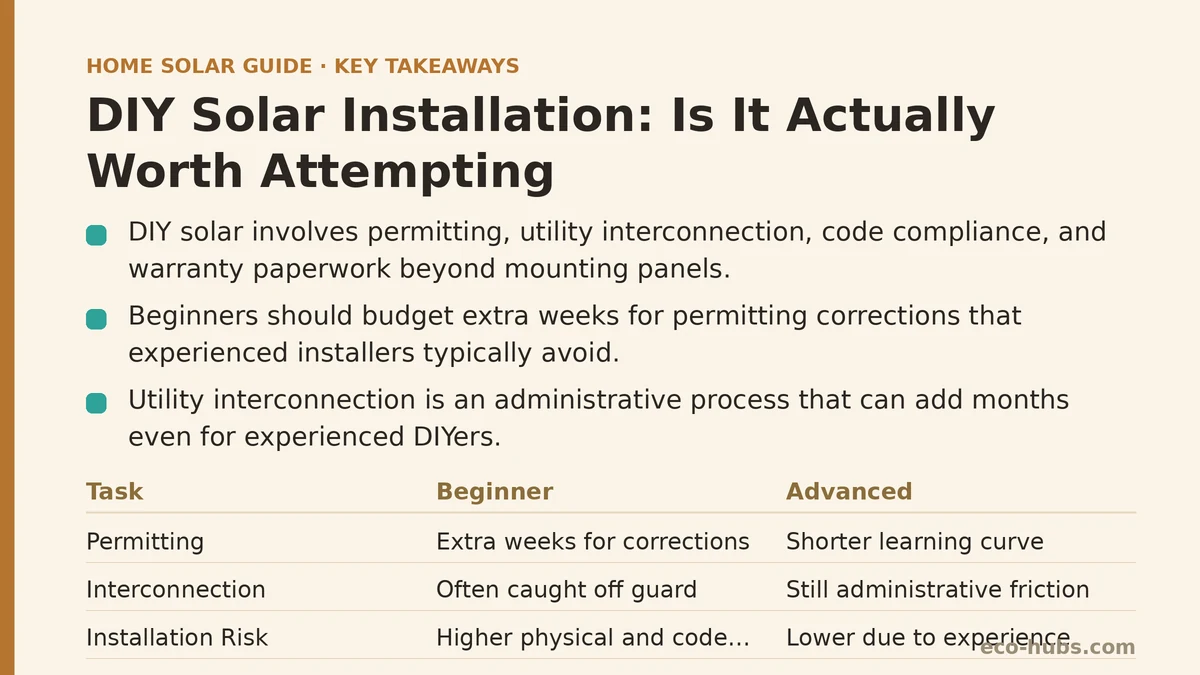
For a beginner, permitting is often the first place the project stalls. Professional installers have existing relationships with local permitting offices and know exactly which forms a specific jurisdiction requires; a first-time DIYer is starting from zero on all of that. This doesn’t make permitting impossible, but it does mean budgeting extra weeks for back-and-forth corrections that an experienced installer would typically avoid on the first submission.
Advanced Profile: Permitting and Paperwork
Someone with contracting or electrical licensing experience is frequently already familiar with the local permitting process from other projects, which shortens this learning curve considerably. Even so, solar-specific permitting requirements sometimes differ from general electrical or construction permits, so this group still benefits from confirming what applies specifically to a DIY solar system rather than assuming general contracting experience covers it automatically.
Beginner Profile: Utility Interconnection
Interconnection approval is where beginners tend to be caught off guard. Net metering, discussed in our dedicated guide, and the ability to run your system alongside grid power both depend on this utility sign-off. Professional installers handle this as routine paperwork; a beginner without that established channel to the utility often finds the timeline and documentation requirements far more involved than expected, sometimes adding months to system activation.
Advanced Profile: Utility Interconnection
An advanced DIYer with electrical background may understand the technical requirements more easily, but interconnection is still an administrative process governed by the utility, not a technical hurdle solved by skill alone. Even experienced homeowners report that this step takes longer than the physical installation itself, so prior electrical competence narrows but does not eliminate the friction here.
Beginner Profile: Installation Risk
Roof work carries real physical risk, and electrical work carries real code-compliance risk — both matter more for a beginner without prior training in either. A wiring mistake that a licensed electrician would catch instantly might go unnoticed by a first-time installer until an inspection fails or, worse, until it causes a problem after the system is energized. This is the category where beginner DIY attempts most often run into trouble.
Advanced Profile: Installation Risk
For someone with real electrical experience and comfortable roof safety practices, this risk drops substantially. Correct wiring, grounding, and mounting are far more achievable when you’ve done comparable work before, even if not on a solar system specifically. This is the group for whom the labor savings discussed in our cost breakdown guide are most realistically attainable without an outsized increase in risk.
Beginner Profile: Tax Credit and Warranty Tradeoffs
As covered in our dedicated tax credit guide, the federal solar tax credit generally covers both equipment and professional installation labor. On a DIY project there’s no labor cost to include, so the credit is calculated on equipment costs alone — a smaller basis than a professionally installed system would generate. Combine that with the loss of a workmanship warranty, detailed in our warranty guide, and a beginner is taking on more financial exposure than the sticker-price labor savings alone would suggest.
Advanced Profile: Tax Credit and Warranty Tradeoffs
The same reduced tax credit basis and warranty gap apply to advanced DIYers too — skill level doesn’t change these two structural facts. What changes is the likelihood of needing that workmanship warranty in the first place. An experienced installer is statistically less likely to introduce the kind of installation error that warranty would have covered, which shifts the cost-benefit math meaningfully in their favor even though the paperwork tradeoffs are identical.
Where the Two Profiles Actually Diverge Most
The clearest divergence between beginner and advanced DIYers isn’t the paperwork — both groups deal with the same permitting, interconnection, and tax credit realities. It’s the installation risk category. A beginner faces meaningfully higher odds of a costly mistake, while someone with electrical and roofing experience is working close to the risk level a professional installer would carry. That single difference is often enough to make DIY worthwhile for one group and inadvisable for the other, even though every other part of the process looks identical on paper.
Comparison at a Glance
| Consideration | Beginner Homeowner | Advanced Homeowner (electrical/contracting background) |
|---|---|---|
| Permitting | Steep learning curve, likely delays | Familiar process, minor solar-specific adjustments |
| Utility interconnection | Often underestimated, adds months | Still slow, but less confusing |
| Installation risk | Highest risk category | Comparable to a professional’s baseline risk |
| Tax credit basis | Reduced, same as advanced group | Reduced, identical structural tradeoff |
| Workmanship warranty | Absent, higher exposure given risk level | Absent, but lower likelihood of needing it |
| Realistic recommendation | Consider a hybrid approach | DIY is more defensible if time allows |
A Middle Path Worth Considering for Either Profile
Neither profile has to choose between fully DIY and fully professional. A hybrid approach — handling preparatory work yourself while bringing in a licensed installer for the core electrical connections, permitting, and interconnection — lets beginners capture some labor savings without absorbing the highest-risk parts of the job, and lets advanced homeowners decide, task by task, where their own skills genuinely offset professional cost rather than assuming the entire project should go one way or the other.
Which profile sounds closer to your situation, and which specific step — permitting, interconnection, or the wiring itself — feels like the biggest unknown for you right now? Tell us where you’re starting from and we can help narrow down whether a full DIY, hybrid, or fully professional approach fits best. Related guides: Net Metering vs Battery Storage: Which Setup Actually Saves More, Is Solar Battery Storage Actually Worth the Additional Cost, and Solar Panel Installation Process Step by Step: What Actually Happens.
🔗 Recommended Reading
- Solar Panel Monitoring Apps: A Setup Guide for Beginners
- How to Read Your Electricity Bill After Solar: A Line-by-Line Walkthrough
- Solar Incentive Paperwork: Common Filing Mistakes That Delay Your Rebate
- Home Battery Sizing Mistakes That Lead to Blackout Regret
- Common Solar Installer Mistakes Homeowners Should Catch Before Signing