Say you are trying to decide whether to sign a solar contract in January or wait until spring, because you have a vague sense that installers are busier in warmer months and you don’t want to get lost in a backlog. Or maybe you’re wondering whether installing in December means you’ll lose out on a full year of production compared to installing in June. Both are reasonable questions, and both point to the same underlying issue: timing affects a solar installation in some real ways and in some ways that get overstated online.
Below is a ranked look at the factors that actually move the needle on when to install, starting with the one that matters most and working down to the ones that barely matter at all.
1. Installer Availability and Scheduling Backlogs
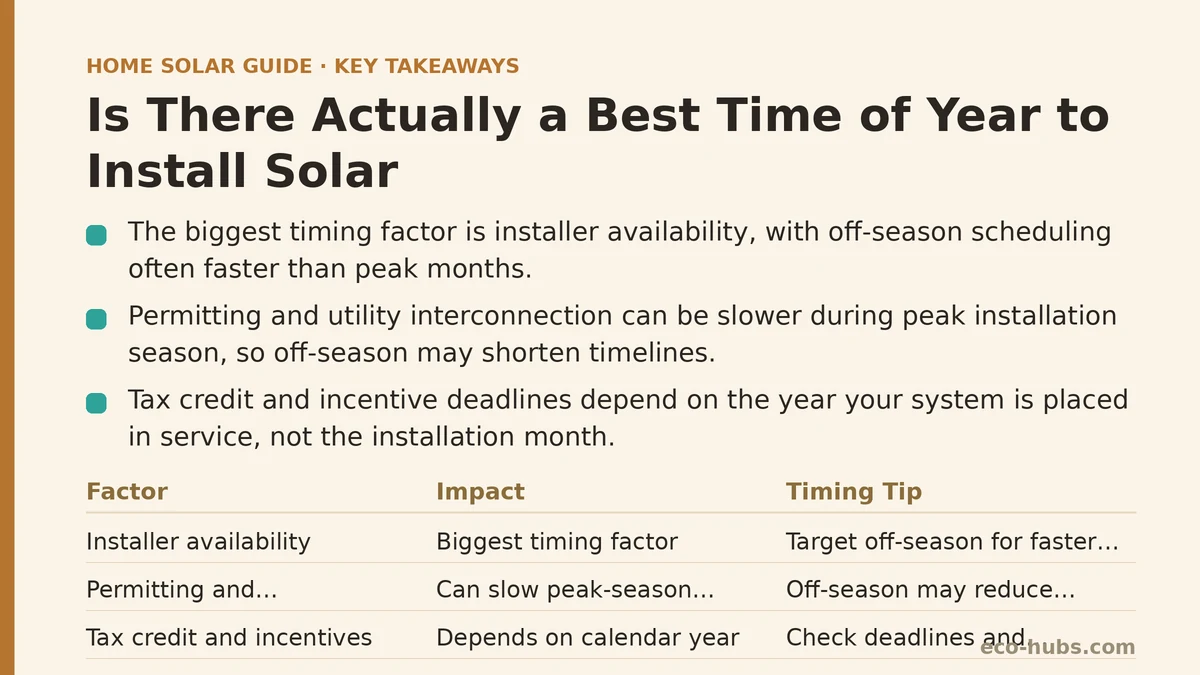
This is the single biggest timing factor, and it has almost nothing to do with weather. Solar installers in most regions see demand spike in spring and early summer, when homeowners are thinking about energy bills after a winter of higher usage and when longer daylight hours make crews more efficient on rooftops. That seasonal surge means longer wait times for a site visit, a proposal, and an installation slot during peak months.
Late fall and winter tend to be quieter for installers in most markets, which can translate into faster scheduling and, in some cases, more room to negotiate on price since crews have more open capacity. If getting your system installed quickly is a priority, targeting the off-season for your specific installer’s market is often more useful than optimizing around sunlight hours.
Worth asking directly: What does your current installation backlog look like, and how does that shift seasonally in this area?
2. Permitting and Utility Interconnection Timelines
As covered in our installer questions guide, permitting and interconnection approval frequently take longer than the physical installation itself. These timelines are set by local permitting offices and utility companies, not by the weather, but they do have their own seasonal patterns worth knowing about.
Some permitting offices see a backlog of their own during peak installation season, since more installers are submitting applications at once. If you install in a slower season for your installer, there’s a reasonable chance the permitting office handling your paperwork is also less backed up, which can shorten the overall timeline from signing to activation more than people expect.
3. Tax Credit and Incentive Deadlines
This factor has nothing to do with the calendar season and everything to do with the calendar year. The federal solar tax credit, discussed in our dedicated tax credit guide, is claimed based on the year your system is placed in service, not the year you signed the contract. If a state or utility incentive program you’re counting on has a funding cap or a scheduled reduction at year’s end, installing before that cutoff can matter far more than whether it’s July or November.
Worth researching directly: whether any incentive you’re relying on has a specific deadline, funding cap, or scheduled step-down, and where your installation needs to land relative to that date.
4. Actual Production Differences Based on Installation Month
Here’s where a lot of the “best time to install” advice gets overstated. Installing in December instead of June does not mean you lose six months of production in any meaningful sense, because your system produces based on the sun exposure available each month going forward, not based on some fixed annual clock that starts ticking at installation. A system installed in winter will simply produce less in its first few months and more once spring arrives, the same as a system installed in summer will produce well initially and then taper off into fall and winter.
Over a full year, and certainly over the 20-plus year lifespan discussed in our system lifespan guide, the installation month has a negligible effect on total lifetime production. The month mostly determines which season your first utility bill under solar happens to reflect, not how much value the system delivers overall.
5. Weather-Related Installation Delays
Physical installation can be affected by weather, mainly rain, snow, or ice that makes rooftop work unsafe. In regions with harsh winters, this can push back a scheduled installation date by days or occasionally weeks. In milder climates, this factor barely registers at all.
This is real, but it ranks last because it’s a scheduling inconvenience rather than something that changes the value or performance of the system once installed. An installer working in a snow-prone region will typically build some buffer into your timeline anyway, so it’s worth asking about upfront rather than treating it as a reason to avoid a particular season entirely.
Ranked Comparison at a Glance
| Rank | Factor | How Much Timing Really Affects It |
|---|---|---|
| 1 | Installer availability | Significant — off-season often means faster scheduling |
| 2 | Permitting and interconnection | Moderate to significant — office backlogs shift seasonally |
| 3 | Tax credit and incentive deadlines | Significant if a specific cutoff applies to you |
| 4 | Lifetime production totals | Minimal — evens out over the system’s lifespan |
| 5 | Weather-related installation delays | Minor in most climates, more relevant in harsh winters |
What This Means for Your Own Timeline
If you’re weighing when to move forward, the strongest case for timing your installation around a specific season has less to do with sunlight and more to do with scheduling capacity, permitting office backlogs, and any hard incentive deadlines on your radar. Production concerns tied to installation month are, for most homeowners, a smaller consideration than the seasonal narrative suggests.
Are you currently deciding whether to install now or wait for a different season? Share what’s driving the hesitation — availability, cost, or an incentive deadline — and it’ll be easier to figure out which of these factors actually applies to your situation. Related guides: Solar Panel Efficiency Degradation Over Time: What Actually Slows Down, Solar Panel Maintenance: What to Actually Expect Over Time, and Community Solar Programs Explained: 5 Program Types Ranked by How Much They Actually Deliver.
🔗 Recommended Reading
- Solar Panel Monitoring Apps: A Setup Guide for Beginners
- How to Read Your Electricity Bill After Solar: A Line-by-Line Walkthrough
- Solar Incentive Paperwork: Common Filing Mistakes That Delay Your Rebate
- Home Battery Sizing Mistakes That Lead to Blackout Regret
- Common Solar Installer Mistakes Homeowners Should Catch Before Signing